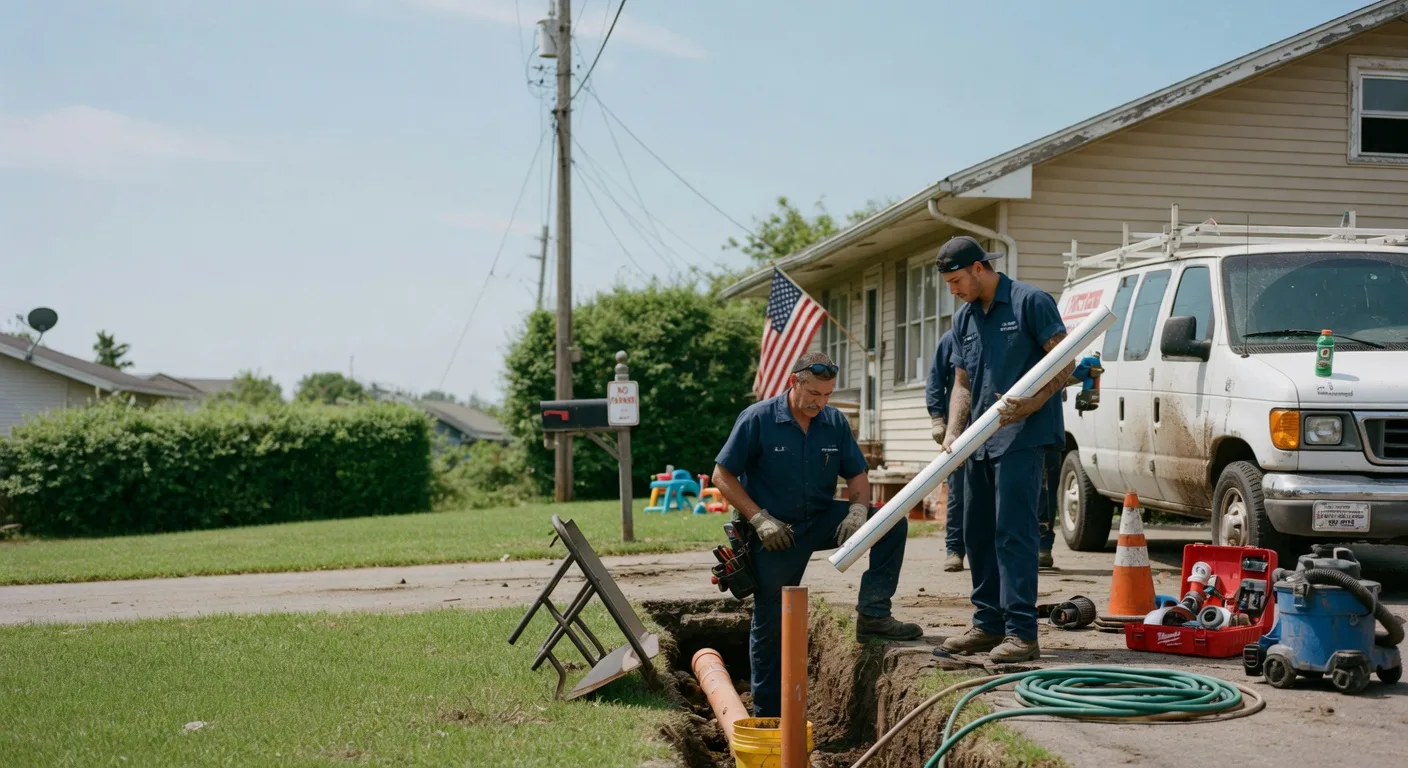
Why did my drains stop working in freezing weather?
Every drain in the house is slow or dead, something is gurgling, and it started on a hard-frost morning. Where Lebanon, OH gets a hard freeze, that usually points to ice in a pipe or ice at the top of the vent stack.
Frozen lines first. In colder states a sewer lateral can sit shallow enough for frost to reach it. Any sagging section holds a little water, and that water turns to ice. An un-insulated drain in a crawlspace or garage can freeze the same way.
Then the vent stack. Warm, damp air rises through the vent and meets freezing air at the roof opening. Frost builds ring by ring until the opening closes. With no air coming in, drains cannot flow. That is the gurgling you hear.
A frozen line and a root blockage look identical from inside the house. Both give slow drains and standing water. The weather, or a camera inspection, tells them apart.
Do not pour boiling water down a frozen line. Sudden heat can crack cast iron or split a trap, and then you have a leak too.
Safe homeowner check: see whether one fixture is slow or every drain is, look at the roof vent from the ground, and feel exposed pipe for a cold, stiff section.
Stop running water and call now if every drain is backing up, water is rising in a tub or floor drain, or you smell sewage. A single slow sink is usually a trap or branch job a cable machine can clear. A whole-house freeze-up or a suspect lateral may need a camera inspection, thawing equipment or hydro jetting, which is where emergency drain cleaning comes in.
Expert Plumbers Co is a referral service. We connect you with an independent local plumber in Lebanon, OH. Call (380) 262-9173.
Once the thaw is done, expect the problem to come back unless the cause is fixed. If a shallow section froze, ask the plumber to note its depth and whether the pipe has a belly that holds water, since that spot will freeze again. A cold crawlspace or garage drain can be wrapped with pipe insulation, and heat tape made for drain lines can help in short cold snaps, but it must be installed to the maker's instructions. For a frosted vent, keep snow clear around the roof opening, and tell the plumber if the vent is narrow, since a wider vent closes up less quickly. In older homes the vent opening is often smaller and the drains less well insulated, so the same cold snap hits harder. After a freeze, watch for leaks at joints and traps as the ice melts, because expanded pipe can split quietly and only show water once it warms. If you see damp spots later, tell the plumber what happened.
Small flies keep coming out of the drain. Is that a clog?
Possibly, but not always. Small flies rising out of a drain are drain flies. They breed in the organic film that coats the inside of the trap and the first few inches of pipe, not in clean standing water. The film is the nursery.
A slow or partly blocked drain gives that film somewhere to sit, which is why flies and a slow drain often show up together. A drain nobody uses is a different case. When its trap dries out, flies and sewer odor both come straight up the pipe.
Safe homeowner check. Tape a card or a clear bag over each suspect drain overnight. Flies on the underside show which one they come from. Clean the strainer and the visible part of the drain. On a rarely used drain, pour in a bucket of water to refill the trap.
A cable machine is enough when one fixture is slow and no flies are involved. A cable only cuts a channel through the blockage and leaves the film on the pipe wall. A line that keeps producing flies after cleaning usually needs hydro jetting, which strips the wall back to bare pipe.
One fixture is a local job. Flies plus several slow drains point further down the line: grease build-up on the pipe wall, a bellied section holding water, or root intrusion at a joint. That calls for a camera inspection before anyone picks equipment.
Stop running water and call if drains gurgle, sewage odor fills the room, or water rises in the lowest fixture.
Expert Plumbers Co is a referral service. We refer homeowners in Lebanon, OH to an independent local plumber for Drain Cleaning. Call (380) 262-9173.
The choice of cleaner matters. Bleach poured down the drain kills flies on contact but leaves the film they feed on, so they return within days. Boiling water helps on metal pipe but can soften or loosen joints on some plastic, so use hot tap water. A stiff brush on the strainer area and the first few inches of pipe does more than any liquid. An enzyme cleaner left overnight can digest the film, but treat it as upkeep, not a cure for a blocked line.
Check the overflow opening on sinks and tubs too. That channel is rarely cleaned and can breed flies.
Adult drain flies are weak fliers and rest on walls near the source, so counting them each evening shows whether cleaning is working. If the numbers do not fall within a week of thorough cleaning, the source is deeper in the line, or in a seldom-used floor drain in a basement or utility room that nobody thinks about.
What should I clear out or get ready before the plumber arrives to unclog my drain?
A little preparation saves time at the door and often means a cleaner, faster job. Most of it takes ten minutes.
Start with access. If the clog is in a sink, empty the cabinet underneath. Plumbers need to reach the trap and the wall pipe, and stored cleaning products tend to be in the way. Put a bucket and some old towels nearby. If the problem is a tub or shower, remove the rugs and anything sitting on the edge.
If the problem might be in the main line, find the cleanout. It is a capped pipe, often three or four inches across, in a basement, a crawlspace, a garage wall, or outside near the house. Clear a path to it. Move boxes, shelves and stored items, and trim back any plants hiding an outside one. If you cannot find it, tell the plumber. Do not try to unscrew an old cap with a hammer.
Pets matter more than people expect. A cable machine is loud, doors will be open, and an anxious dog or a cat slipping into a crawlspace is a real problem. Put animals in a closed room or a different part of the house.
Next, write a short list of which fixtures are affected. For example: the kitchen sink is slow, the downstairs shower gurgles, the toilet is fine. Add when it started and whether it happens only when the washer runs or when it rains. That list tells the plumber whether to look at a branch line or the main line before anyone touches a tool.
Also stop doing a few things. Do not pour chemical drain cleaner in before the visit, since it can burn skin and make the pipe unsafe to work on. If you did already, tell the plumber what you used.
Finally, if water is coming up through a floor drain or toilet right now, stop running water in the house and keep children and pets away from it. Call straight away rather than waiting to tidy up.
Cost depends on access, so a clear path to the pipe can help keep the visit short.
If you need a drain cleared in Lebanon, OH, Expert Plumbers Co can connect you with an independent local plumber at (380) 262-9173.
Can I rent a hydro jetter or a big drain machine and do the main line myself?
"Can I just rent a hydro jetter and do the main line myself?" You can rent one at many tool shops, so it is a fair question. The honest answer is that it is a bad bet on a main line, for reasons of both pipe and safety.
A hydro jetter pushes water at very high pressure through a hose with a nozzle that pulls itself down the pipe. In the right hands, on sound pipe, it cleans grease and scale off the pipe wall. In the wrong hands it can break old clay or cast iron, wash out joints, drive water into a cracked pipe, or punch through a thin spot. Root intrusion at a clay joint can hold the nozzle, and a bellied line can trap it.
A large drain machine has its own risk. The spinning cable can whip, snag and twist. It can wrap a hand or arm in a second.
There is a bigger issue. Without a camera, you do not know what you are cutting. A main line that backs up may be roots, a bellied line, a collapsed section or a failed sewer lateral. Clearing the blockage may only open a hole through it, and it returns soon after.
Safe homeowner check: Run one fixture at a time and note which drains slowly. Check if it is one fixture or every drain in the house. Do not pour drain chemicals into a line that is backing up.
Stop running water and call now if sewage is coming up in a tub, shower or floor drain, the toilet bubbles or rises when you run other fixtures, or you smell sewage in the house. Stop using water in the house until the line is cleared.
A cable machine is enough for a simple clog in a branch line. Hydro jetting is for grease and scale on the pipe wall. A camera inspection is the step that tells the plumber what is in the pipe and what tool is safe to use, which is what a rental cannot give you.
Expert Plumbers Co is a referral service. We connect you with an independent local plumber in Lebanon, OH. Call (380) 262-9173.
Ask the plumber to show you the camera footage and explain what was found. Ask whether the pipe is sound enough for jetting. Cost depends on access to a cleanout, the parts or materials needed, how much has to be opened up or removed to reach a damaged section, and any permit or code requirement.
I opened the cleanout and it is full of water. Which side of the cleanout is the blockage on?
You pulled the cap on the cleanout and instead of an empty pipe you are looking at standing water. That tells you something useful. Water sitting in an open cleanout means the blockage is downstream of it, toward the street. The pipe is backed up behind the stoppage, and the cleanout is just a window into it.
The reverse also holds. If the cleanout is dry and you still have backups inside the house, the blockage is upstream, between the cleanout and your fixtures.
The usual causes of a full cleanout are root intrusion at a clay joint, a bellied line that holds water and solids, grease build-up on the pipe wall, or a failed sewer lateral where the pipe has collapsed or shifted. Water that holds steady and drains slowly suggests a partial blockage. Water that rises when someone flushes suggests a full one.
One slow fixture is usually a problem in its own branch line. When every drain in the house is slow, gurgling or backing up, especially the lowest tub or floor drain, the main line is the problem. Gurgling at several fixtures can also mean a blocked vent stack, so mention it to the plumber.
Safe homeowner check: Stop using water in the house. Look at the water level in the cleanout without touching the cap again. Note whether it is rising, falling or steady, and which fixtures backed up first. Keep children and pets away from the area.
Stop running water and call now if sewage is coming up in a shower, tub or floor drain, if the cleanout water is rising, or if you smell sewage indoors. Never loosen a cleanout cap under pressure, because sewage can surge out with force. Do not flush or run the washer while you wait.
A cable machine is often enough for a soft stoppage such as paper, grease or roots in an otherwise sound pipe. Hydro jetting is the better tool when grease or scale coats the pipe wall and a cable only punches a hole through it. A camera inspection is the right step when the blockage keeps coming back, when water stands in the line, or when a bellied or broken pipe is likely.
Expert Plumbers Co is a referral service. We connect you with an independent local plumber in Lebanon, OH. Call (380) 262-9173.
Tell the plumber the cleanout is full and where it sits. Ask whether they will run a camera after clearing the line and show you the footage. The scope depends on access to the cleanout, how deep the blockage is, whether the pipe is damaged, and whether a repair means digging or a permit.